
Underrated Profit Centers in a High-Cost Concert Market
Updated 2026
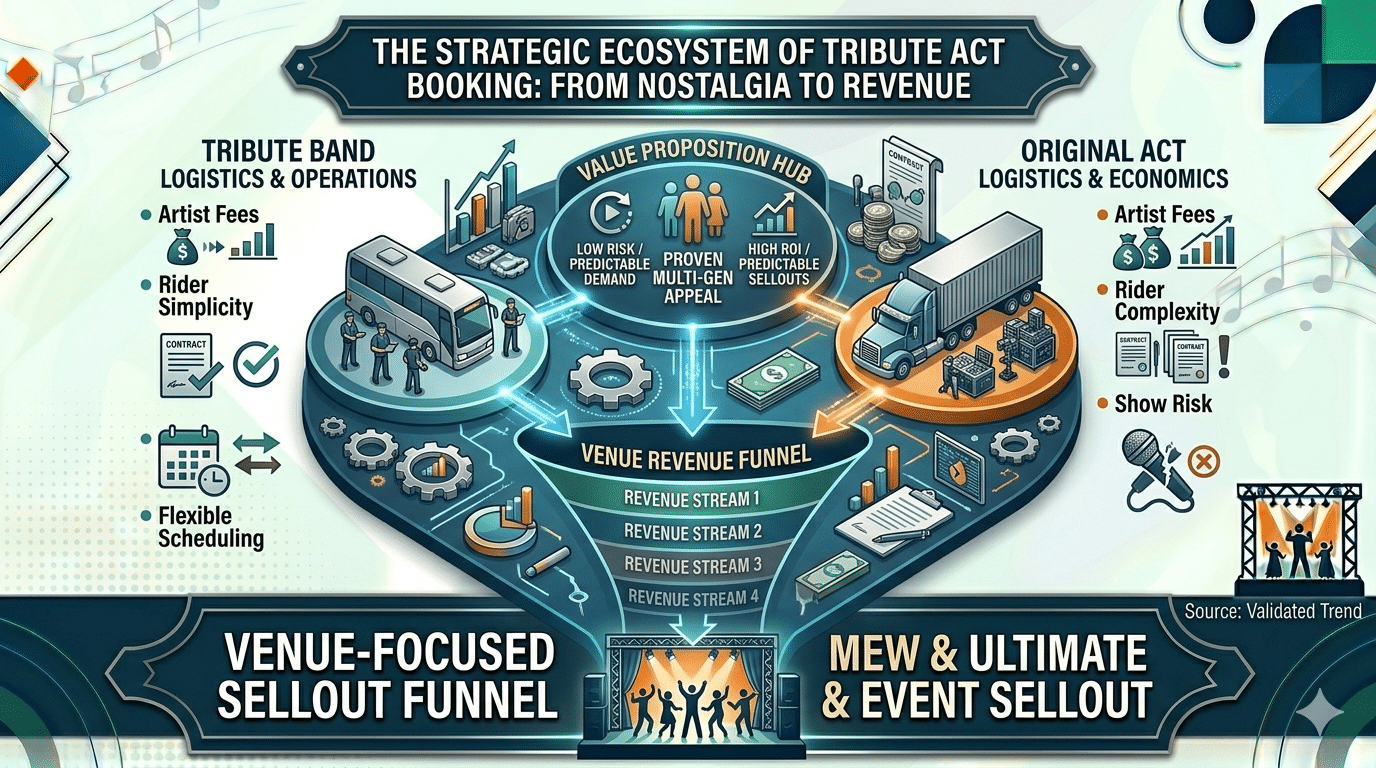
In an industry obsessed with star power, viral moments, and massive productions, one of the most consistently profitable segments of live entertainment doesn’t require original music, huge marketing budgets, or celebrity riders. Tribute bands—acts that channel the energy, look, and sound of iconic performers from The Beatles and ABBA to Queen and Journey—are emerging as an underrated but highly reliable profit center for venue operators, talent buyers, concert promoters, and fair organizers.
And the timing couldn’t be better. With average U.S. concert ticket prices hitting $144 in 2025—up 45% from 2019 [1]—and live entertainment revenue softening 6% from 2024’s record highs [2], fans are becoming increasingly selective about where they spend their entertainment dollars. Tribute bands offer audiences the full emotional payoff of a live concert at a fraction of the price, and they offer promoters the risk-reduction they need in a tightening market.
The Market Context: Why Tribute Bands Are Having a Moment
The U.S. live music market reached $18.51 billion in 2025 [3], yet the growth is increasingly concentrated at the very top. Mega-tours by Taylor Swift, Beyoncé, and Bad Bunny command average ticket prices exceeding $300–$1,000+ [4], while mid-tier touring is experiencing fan resistance. According to Pollstar data, the broader live entertainment market grossed 6% less in 2025 than 2024’s record peaks [2]. Tribute booking agents report that Live Nation itself has increasingly turned to tribute acts to fill venue calendars and reduce financial exposure [2].
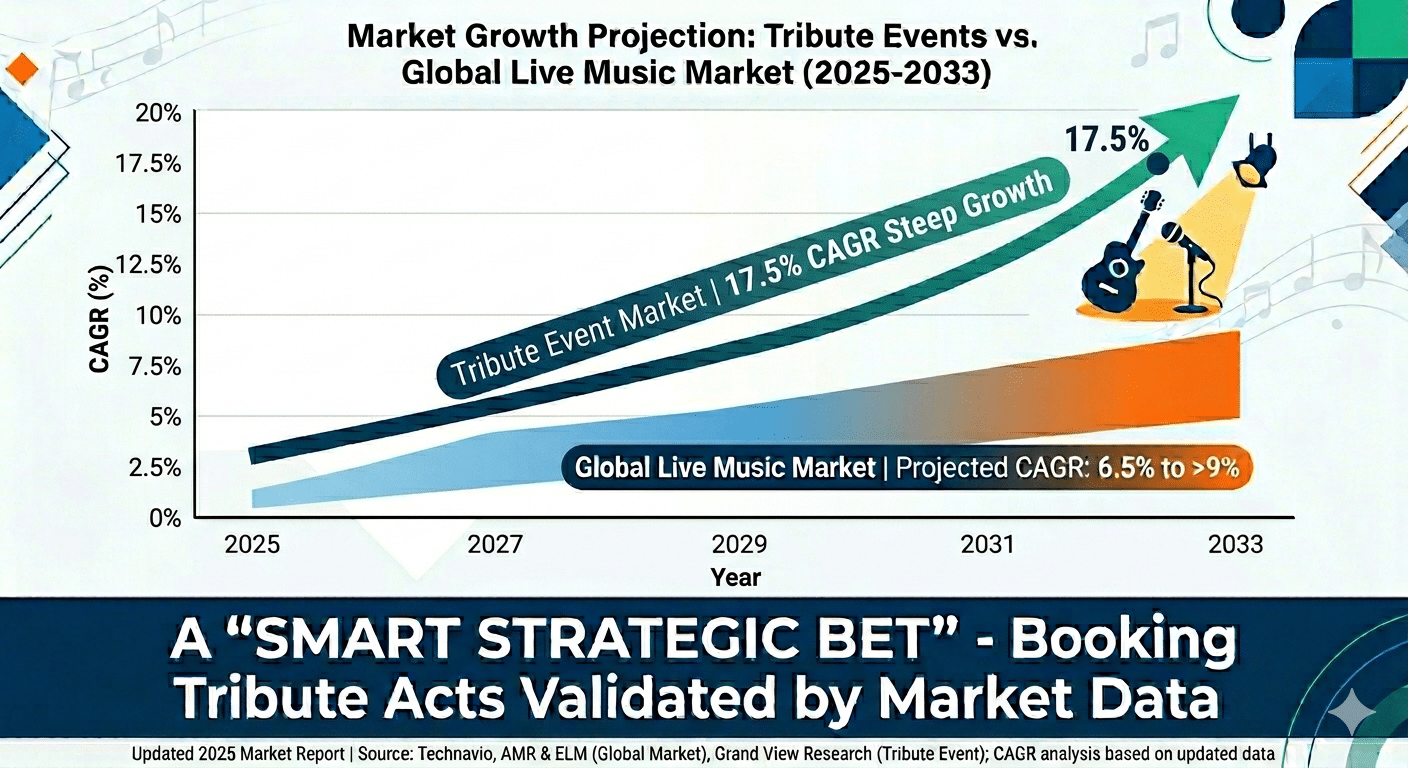
The growth numbers tell a compelling story. The global live music market overall is projected to grow at a CAGR of 6.5% from 2025 to 2033 [9]. By contrast, demand for tribute and themed entertainment events is projected to grow at a CAGR of 17.5% over the same period [5]—nearly three times faster. That gap reflects a structural shift in how fans are consuming live music: seeking the emotional experience of a great show without the premium price tag of a superstar tour. For event operators, that divergence is a significant opportunity.
What Makes Tribute Bands So Appealing?
Tribute bands hit a sweet spot that few other acts can claim:
- Familiarity: Audiences already know every song, and nostalgia is a measurable driver of attendance and spending.
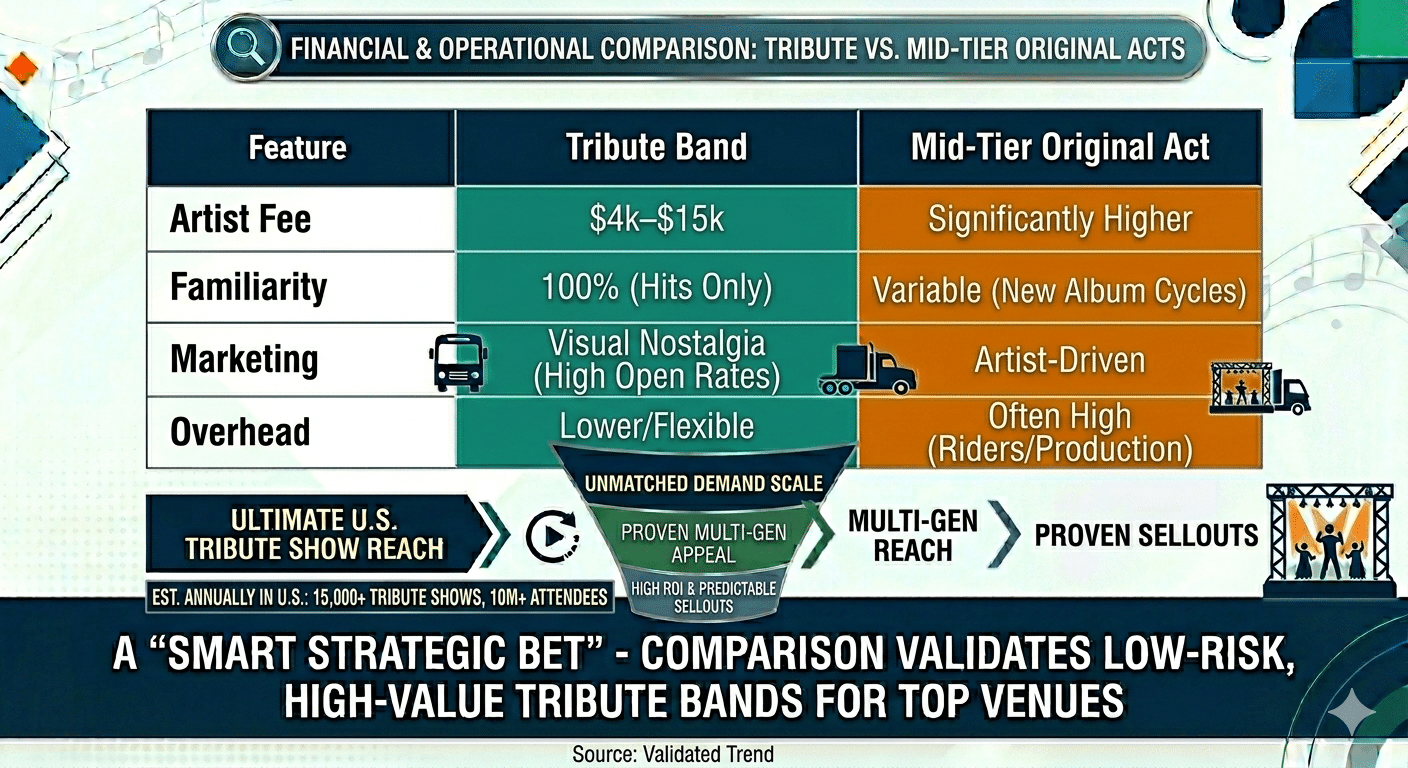
- Affordability: Most quality tribute acts route at $4,000–$15,000 as a flat guarantee—a fraction of what even mid-tier original acts command.
- Versatility: These acts fill theaters, casinos, corporate events, festivals, wineries, county fairs, and cruise ships.
- Professionalism: Many tribute acts operate like well-oiled touring machines, with experienced musicians and managers who understand the business side.
In a marketplace where risk mitigation is vital, tribute bands offer a high-return, low-risk booking option.
Tribute Bands vs. Cover Bands: What’s the Difference?
While the terms are sometimes used interchangeably, there are key distinctions:
- Cover bands perform a mix of popular songs from multiple artists.
- Tribute bands focus on emulating one specific artist or band—replicating exact setlists, costumes, and stage presence.
The best tribute bands don’t just play the music—they recreate the experience. Audiences walk away feeling like they’ve seen the real thing, which drives repeat attendance and word-of-mouth.
Audience Demographics and the Nostalgia Advantage
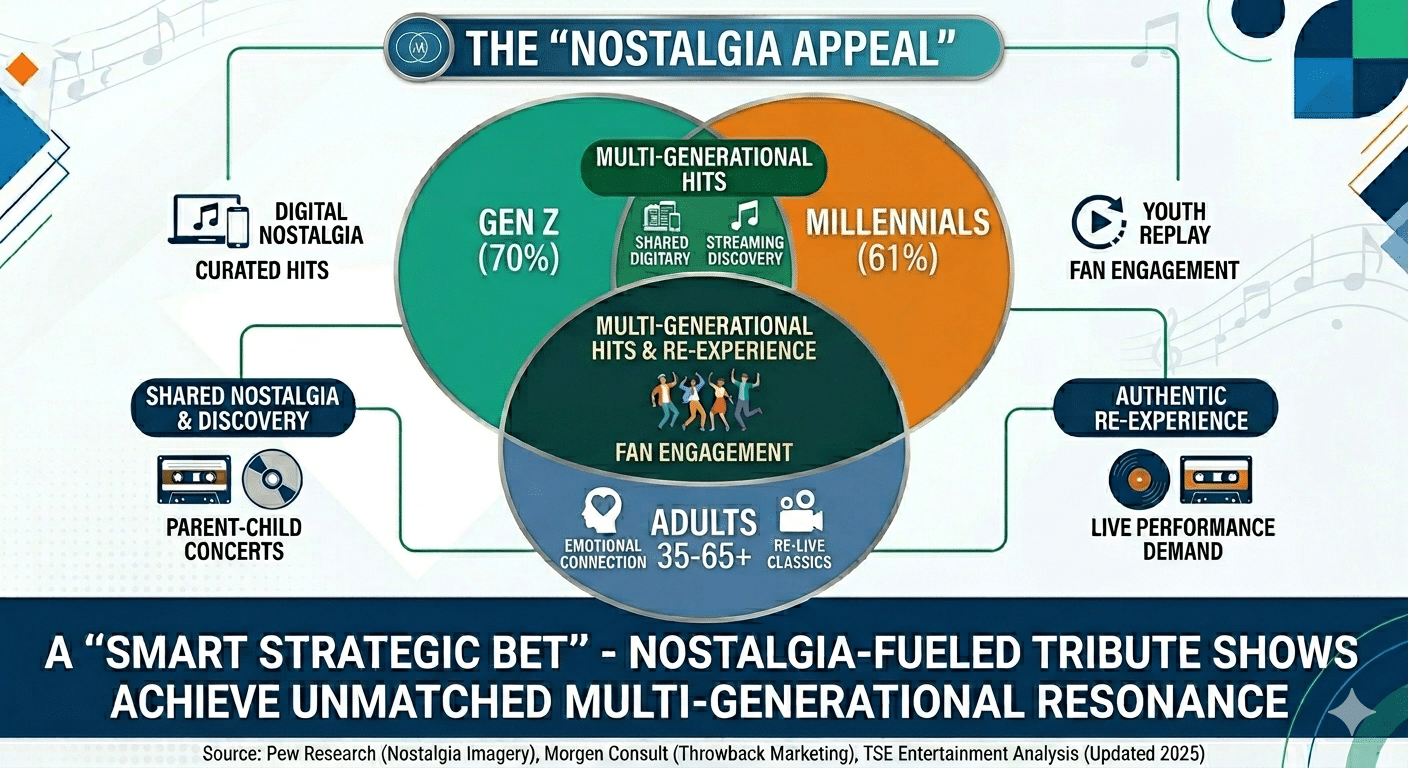
Tribute band audiences tend to skew toward adults aged 35–65+, often with disposable income and a strong emotional connection to the music. According to Pew Research, people aged 35–54 are most strongly affected by nostalgic imagery tied to their youth [6], and this demographic controls a large share of consumer spending. Nielsen data shows that 61% of Millennials say nostalgia improves their perception of a brand and drives buying intent [6].
Critically, the appeal extends beyond older fans. A Morning Consult survey found that nearly 70% of Gen Z consumers respond positively to throwback marketing even if they didn’t live through the era [6]. This multi-generational dynamic is a hallmark of tribute shows: parents bring children to share the music they grew up on, while younger fans who discovered classic artists on streaming platforms attend to experience them live.
This audience mix delivers tangible revenue benefits. Older attendees are statistically more likely to purchase higher-margin beverages, VIP upgrades, and merchandise—translating to strong food-and-beverage per-cap numbers that boost overall event contribution.
Why Tribute Bands Make Sense for Venue Operators
From a business standpoint, tribute bands check a lot of boxes:
- Predictable Draws: Acts like The Fab Four (Beatles) or Rumours (Fleetwood Mac) have consistent followings and reliable ticket-sale patterns.
- Lower Overhead: No pyrotechnics, elaborate stage builds, or excessive greenroom demands in most cases.
- Flexible Routing: Many tribute acts tour regionally, reducing travel expenses and enabling routing clusters that benefit multiple venues.
- Year-Round Viability: Unlike original artists tied to album cycles, tribute acts perform year-round.
- Strong F&B Sales: Older audiences are more likely to purchase higher-margin beverages such as wine and cocktails.
- Recession Resilience: When the broader entertainment market softens, tribute bookings hold. As one industry booking agent noted, “the big concerts will go before tributes go” [2].
For Concert Promoters and Talent Buyers
Tribute bands can round out your calendar without cannibalizing your budget. Consider:
- Filling off-nights or shoulder seasons when headline acts aren’t available.
- Creating themed event series (e.g., “Legends of Rock” or “Decades” nights) to build habit and repeat attendance.
- Offering VIP or package deals for superfans—meet-and-greets, signed setlists, and premium seating.
- Testing markets: A tribute act is a cost-effective way to gauge local demand before chasing a legacy original act.
Promoters can also package multiple tribute acts for mini-festivals—pairing a Journey tribute with a Foreigner tribute, for example—to boost ticket sales and give audiences more perceived value.
The Festival and Fair Advantage
Fair and festival organizers consistently need to maximize limited budgets, appeal to multigenerational crowds, and avoid logistical nightmares. Tribute bands meet all three criteria. They’re also excellent partners for theme nights, decade throwbacks, and sponsor activations.
A 1980s-themed festival featuring a Journey or Prince tribute creates opportunities for era-specific décor, sponsor tie-ins, and themed F&B—building a more immersive and profitable guest experience. Organizers also find tribute acts easier to promote because marketing can lean heavily on visual nostalgia, and nostalgia-themed content demonstrably outperforms neutral messaging: nostalgic subject lines in email campaigns show a 19% higher open rate [6], and nostalgic brand campaigns have been shown to generate a 16% sales lift in related research [6].
For Queen’s tribute brand alone, more than 11,000 people globally search for Queen tribute bands each month, with The Beatles and Journey ranking as the top two most-searched tribute brands in the U.S. [7]. These search volumes are an organic proxy for local demand before you ever spend a dollar on marketing.
Production and Technical Considerations
Most tribute bands travel light. Standard requirements typically include a 24–32 channel input list, 4–6 monitor mixes, house PA, and basic lighting. Many acts bring their own backline or engineer, reducing reliance on in-house staff. This adaptability makes them suitable for small clubs, theaters, and large outdoor stages alike.
Some higher-level acts replicate the elaborate stage setups of their source artists—pyrotechnics for a KISS tribute, laser shows for a Pink Floyd tribute—offering promoters the ability to book a near-authentic production experience at a fraction of the original’s price.
The Role of Agencies and Representation
TSE Entertainment is widely regarded as one of the top agencies for booking tribute acts. With more than 50 years of experience in the live entertainment industry, TSE has built a strong reputation for representing some of the most authentic and high-quality tribute bands in the business. Their extensive roster, professional support, and industry connections make them a go-to partner for venues, festivals, and event organizers seeking reliable, crowd-pleasing acts.
Revenue Opportunities Beyond Tickets
Tribute bands open the door to creative revenue streams beyond the box office:
- VIP Meet-and-Greets: Fans will pay $25–$100 to meet their favorite Elvis or Stevie Nicks impersonator.
- Merchandise: Tribute acts offer branded merch that resonates with fans and typically yields 0–20% to the venue.
- Sponsorship Tie-ins: Nostalgia is a powerful marketing theme for local and regional sponsors.
- Food & Beverage: Older audiences spend more per capita at the concession stand.
- Cross-Promotions: Pairing tribute shows with local breweries, wineries, or restaurants creates mutually beneficial promotional opportunities.
- Streaming Add-Ons: Some tribute acts now offer live-streamed or hybrid-format concerts, expanding reach and creating new monetization.
Success Stories and Case Studies
- Bohemian Queen (Queen Tribute): Routinely sells out 500–1,500-seat theaters and has successfully worked the corporate and cruise ship markets.
- The Purple Xperience (Prince Tribute): Developed a multi-year festival circuit presence with dedicated fanbases.
- ABBA Revisited: Frequently headlines at casinos and high-end private events.
- BritBeat (Beatles Tribute): Built an international following and performs regularly at destination venues.
- Elvis Tribute Circuits: Among the longest-running and most lucrative tribute niches, with entire festivals built around them.
Risks and How to Mitigate Them
Like any booking, tribute acts come with potential challenges:
- Quality Variance: Not all tribute acts are created equal. Use full-song live video reels (not just sizzle reels), references, and agency feedback.
- Brand Confusion: Make it clear in all marketing materials that it’s a tribute act, including the disclaimer “not affiliated with or endorsed by [Artist].”
- Overexposure: Rotate acts to avoid audience fatigue. A 6–12 month cadence is appropriate for most markets.
- Legal Considerations: Ensure marketing materials do not infringe on trademarks; reputable tribute acts already understand these limitations.
Marketing Tribute Acts Effectively
Booking a tribute band is only half the battle—marketing is what drives ticket sales. Best practices include:
- Lean into Nostalgia: Use era-specific imagery and taglines that remind audiences of the artist. Research confirms that nostalgia makes brands feel more authentic to 70% of consumers [6].
- Leverage Social Media: TikTok nostalgia-related hashtags grew 130% year-over-year from 2024 to 2025 [6]—a ripe channel for tribute promotion.
- Bundle Experiences: Create ticket + dinner or ticket + VIP drink packages to increase average transaction value.
- Email Marketing: Nostalgia-themed email campaigns generate 19% higher open rates [6]. Target established fanbases for strong conversion.
- Engage Local Media: Nostalgic storylines resonate with journalists and make press coverage easier to secure.
- Use Theme Nights: Pair the act with costume contests, giveaways, or themed cocktails to boost engagement.
Pricing & Deal Structures (Guarantee vs. Split)
- Flat Guarantee: Simple and low-friction. Best when you expect moderate demand and want predictable costs. Most high-quality tribute acts run $4,000–$15,000 depending on market size, routing, and production.
- Versus Door Split: Artists receive a percentage of gross ticket sales (e.g., 70/30 in favor of the artist) after approved expenses. Useful when demand is uncertain but potentially strong.
- Hybrid Deals: A guarantee vs. percentage (e.g., $7,500 vs. 70% after expenses). If the split yields more than the guarantee, the artist takes the higher amount. Aligns incentives while capping downside.
- Bonuses & Upside: Add sell-out bonuses or tiered back-end (e.g., +$1,000 at 90% capacity; +$1,500 at sellout) to reward performance.
- Radius & Exclusivity: Protect your market with 30–90 day radius clauses and 50–150 mile boundaries, tuned to population density and media reach.
- Merch & Ancillary: Clarify merchandising splits (often 0–20% to venue), photo policies, and on-site sponsor displays to avoid settlement surprises.
Sample P&L: 800-Cap Theater (Illustrative)
Assumptions
- Ticket price (all-in average): $35
- Capacity: 800; expected attendance: 75% (600 tickets)
- Artist fee (guarantee): $8,000
- Production (audio/lights/backline/engineer): $2,500
- Marketing (digital, radio, print): $2,500
- Staffing/security/FOH/box office: $2,200
- PRO/licensing (ASCAP/BMI/SESAC estimate): $300
- Contingency/misc.: $500
Results
- Ticket Gross: 600 × $35 = $21,000
- Total Expenses: $16,000
- Net from Tickets: $5,000
- F&B Revenue (per-cap $18): 600 × $18 = $10,800
- Total Event Contribution: $15,800
Sensitivity Check
- 60% capacity (480 tickets): $9,440 total contribution
- 90% capacity (720 tickets): $22,160 total contribution
- Break-even: ~457 tickets (~57% capacity)
4-Week Marketing Sprint (Template)
Note: Ideal timeline is 3–4 months from teasers to show.
Day 28 to 21
- Confirm hero assets, write press release, build event page with strong SEO (artist + “tribute” + city).
- Set up pixels, UTMs, and conversion events. Build email segments (past buyers, genre fans, VIPs).
- Launch announce: email + organic socials; open early-bird allotment (limited quantity to drive urgency).
Day 21 to 14
- Turn on paid social (lookalikes + retargeting), Google Performance Max/brand search, and event listings (Bandsintown, local calendars).
- Drop short Reels/TikToks with recognizable hooks; encourage the band to cross-post.
- Pitch local media with nostalgia angles and giveaways.
Day 14 to 7
- Fresh creative: swap ad copy and thumbnails to fight fatigue.
- Partner promos with breweries/wineries; bundle ticket + drink packages.
- Email #2: “Setlist preview + VIP perks.”
Day 7 to 1
- Increase retargeting frequency; add countdown posts.
- Launch UGC contest (best era outfit wins VIP upgrade).
- Final email: “Low tickets / limited VIP.” Enable SMS reminder 24–48 hours out.
Creative note: Use era-evocative colors, fonts, and taglines; always include “A Tribute to ____” to avoid brand confusion.
Ops & Advancing Issues and Checklist
- 6–4 weeks out: Exchange tech/hospitality riders; confirm power, stage plot, and load-in times. Lock hotel and ground transport.
- 3 weeks: Share detailed day-of schedule, dressing room map, Wi-Fi, and settlement method.
- 2 weeks: Finalize staffing, volunteer needs, and security plan; confirm ADA seating.
- 1 week: Re-send promo plan to artist for cross-posts; confirm backline and patch list.
- Show day: On-time load-in; soundcheck; door times; set lengths; photo policy; hard curfew.
- Settlement: Reconcile box office, proof of expenses, merch count, and sign-offs.
Legal/IP & Branding Guardrails
- Market as “A Tribute to [Artist]”; add “not affiliated with or endorsed by [Artist]” language.
- Avoid official logos and trademarked fonts; rely on evocative-but-original creative.
- Clarify image rights for photos and video.
- Confirm PRO reporting (ASCAP/BMI/SESAC) and any recording restrictions.
Note: Tribute bands typically do not pay royalties directly for live performances—venue PRO licenses cover composition rights [2].
KPIs to Track
- Attendance %: Tickets sold ÷ Capacity
- Revenue per Attendee (RPA): (Ticket revenue + F&B + merch) ÷ Attendance
- F&B Per Cap: F&B revenue ÷ Attendance
- Marketing ROAS: Attributed revenue ÷ Ad spend
- Cost per Ticket Sold (CPTS): Ad spend ÷ Tickets sold via ads
- Email Conversion: Tickets sold from campaign ÷ Delivered emails
Benchmark these show-to-show to refine offers, media mix, and pricing.
Programming Strategy & Calendar Design
- Anchor a “Legends Night” series (first Fridays) with rotating tributes to build audience habit.
- Use tributes to seed new markets—validate demand before chasing legacy originals.
- Pair with community events (car shows, wine walks) for built-in foot traffic.
Sponsorship Packages (Illustrative)
- Bronze ($2,500): Logo on assets, 4 tickets, in-show mention.
- Silver ($5,000): All Bronze + booth space, 8 tickets, email feature.
- Gold ($10,000): All Silver + presenting rights (“Presented by ___”), VIP lounge branding, 20 tickets.
- Add-ons: Naming a signature cocktail, backstage tour for clients, co-branded content.
Final Thoughts: A Win-Win Business Model
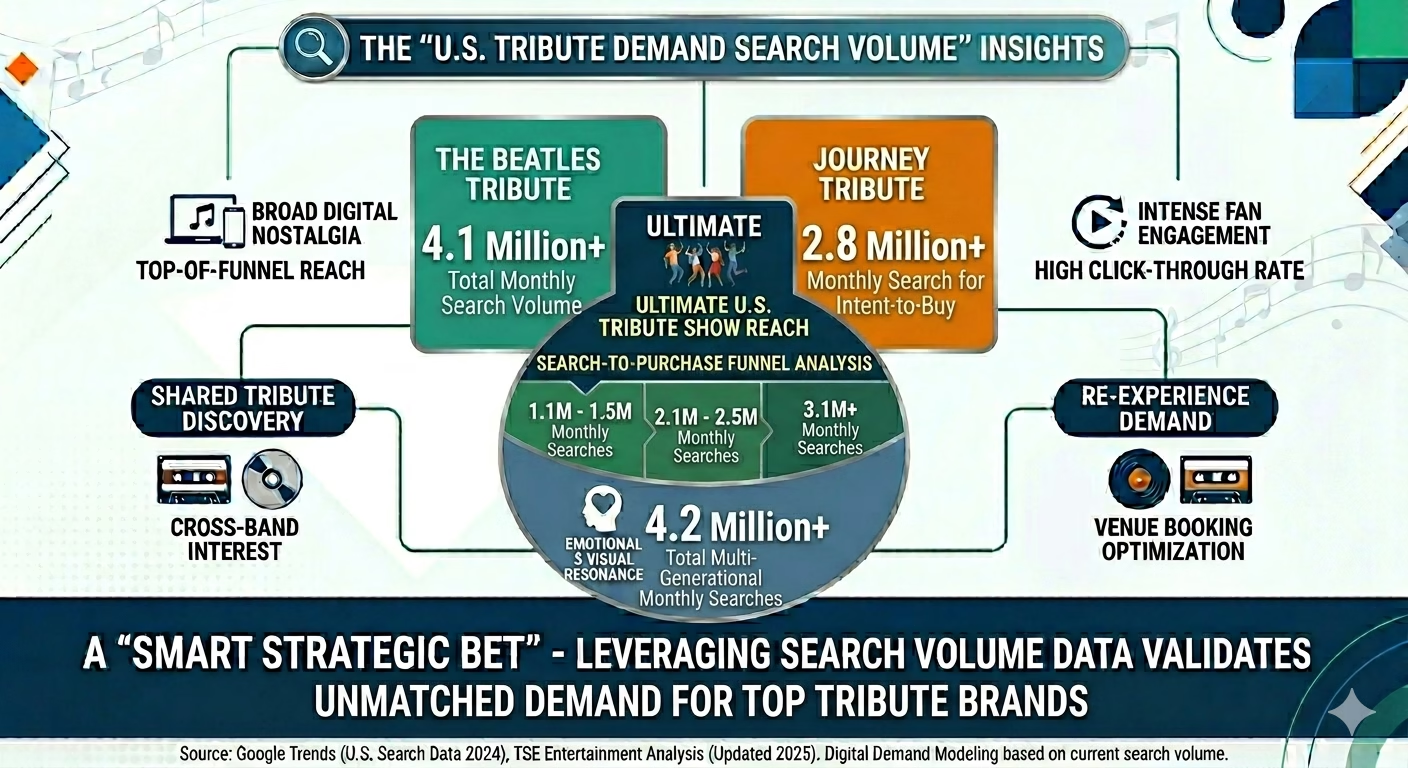
Tribute bands aren’t just a placeholder between big shows. They are a proven draw, a cost-effective solution, and a high-margin opportunity for entertainment bookers. In an era where average concert ticket prices have surged 45% since 2019 [1] and the broader market is showing signs of demand fatigue at the high end [2], tribute bands offer something increasingly rare: consistent, accessible entertainment that delivers emotional value at a price point audiences can sustain.
Whether you operate a 350-seat theater, a mid-size outdoor venue, or program a regional fair, tribute bands could be your most underrated profit center.
Start thinking less about who wrote the songs, and more about who can deliver the experience your audience craves. Because in the end, great entertainment is about connection—and tribute bands deliver that in spades.
TSE Entertainment is here to help. Our extensive roster, professional support, and decades of industry relationships make us a go-to partner for venues, festivals, and event organizers seeking reliable, crowd-pleasing acts.
FAQ: Tribute Bands for Talent Buyers, Venues & Fairs
1) What do reputable tribute bands typically cost?
Most quality tributes route between $4,000–$15,000 as a flat guarantee, depending on region, routing, production, and brand strength. Theater/casino headliners or specialty productions can exceed that range.
2) Should I book a flat guarantee or a door split?
If demand is steady but not explosive, a flat guarantee keeps costs predictable. When you expect strong sales—or want shared risk—use a hybrid (e.g., $7,500 vs. 70% after approved expenses). Pure splits work for clubs or new markets but require meticulous expense definitions.
3) How do I forecast attendance?
Use comps (previous tributes, legacy acts), email list density, social engagement, streaming/radio popularity in your DMA, and Facebook/Google Event RSVPs. Model 60% / 75% / 90% capacity scenarios and compute break-even: (Fixed Costs) ÷ (Avg Ticket Price).
4) What ticket price should I set?
A common range for theaters is $25–$49. Start with a tiered ladder (Early Bird → Advance → Standard → Last-Minute) and protect a price floor to avoid devaluing future shows. Add VIP packages (preferred seating + M&G + signed setlist) for incremental margin.
5) How long is the typical show?
Most tribute acts deliver 90–120 minutes, either straight through or 2 × 50–60 minutes with a short intermission.
6) What’s normal for radius/exclusivity?
Common language is 30–90 days and 50–150 miles, tuned to population density and media reach. Tighten restrictions when you invest more in marketing.
7) Are there legal/IP issues?
Advertise as “A Tribute to [Artist]” and include a simple disclaimer (“not affiliated with or endorsed by [Artist]”). Avoid official logos and trademarked fonts. Your venue PRO license (ASCAP/BMI) covers performance of compositions.
8) Do meet-and-greets actually sell?
Yes. Price $25–$100 depending on act/venue. Deliver value: early entry, photo op, signed setlist or laminate, and a quick Q&A.
9) What’s a proven marketing timeline?
Allow 3–4 months from teaser to show date. The 4-week sprint (above) handles the final push, but early awareness is critical for driving early-bird sales and building social momentum.
10) Are tributes a fit for all-ages, casinos, or corporate?
Absolutely. They adapt set length and content to context. Casinos like predictable draw; corporate buyers value instant recognizability; all-ages shows benefit from multi-generational appeal.
Sources
Statistics cited throughout this article are sourced from the following:
[1] TicketHold Research — “Ticket Prices Soar in Major Cities as Fans Face Funflation” (May 2025) — Average U.S. concert ticket price $144, up 45% from 2019.
[2] Marketplace (NPR) — “Why Tribute Bands Are Having a Moment” (December 31, 2025) — Live Nation booking tribute acts; Pollstar analysis showing live entertainment gross down 6% from 2024’s record highs; PRO licensing commentary.
[3] AMW Group — “Live Music & Touring Statistics 2026” (February 2026) — U.S. live music market size $18.51 billion in 2025.
[4] Consequence.net — “The Model Is Broken: Why Concert Tickets Are So Expensive” (December 2025) — Pollstar top 100 tour average $135.92 in 2024; ticket inflation trends.
[5] Grand View Research — “U.S. Music Tourism Market Size & Industry Report, 2033” — Demand for tribute events projected to grow at 17.5% CAGR from 2025 to 2033.
[6] AMRA & ELMA — “Best Nostalgia Marketing Statistics 2025” — Pew (ages 35–54 most affected by nostalgia), Nielsen (61% of Millennials), Morning Consult (70% of Gen Z), Kantar (16% sales lift), TikTok/IMH (130% hashtag growth YoY), Campaign Monitor (19% higher email open rates).
[7] ProTributeBands.com — “2024 Mid-Year Tribute Brand Rankings” — Google search volume data; Queen #1 globally (11,000+ monthly searches); Beatles and Journey #1 and #2 in the U.S.
[8] Technavio — “Live Music Market Size to Grow by USD 18 Billion from 2024 to 2029” (December 2024) — Global live music market CAGR of 11.2%; North America accounts for 35% of growth.
[9] Strategic Revenue Insights — “Live Music Market” (2025) — Global live music market projected CAGR of 6.5% from 2025 to 2033.
Related Post: