

Stage collapses rarely happen without warning. Structures almost always “communicate” stress, instability, and impending failure through visible signs. Recognizing those signs and acting on them is the difference between a successful event and a tragedy.
The most common phrase in post-incident investigations is:
“There were warning signs, but no one recognized them or acted in time.” |
This finding has appeared in the aftermath of the 2011 Indiana State Fair collapse that killed 7 people, the 2011 Ottawa Bluesfest stage collapse, the 2012 Radiohead stage collapse in Toronto, and dozens of other incidents worldwide. The pattern is consistent: the structure communicated. People either didn’t see the signs, didn’t understand them, or didn’t feel empowered to act.
This article identifies the 15 most critical red flags that indicate outdoor stage structures are at risk of failure, supported by real-world incident data and engineering investigation findings.
Why Stages Fail: The Root Causes
Engineering investigations of stage collapses consistently identify a cluster of root causes:
- Structural design inadequate for actual wind loads or site conditions
- Ballast systems under-specified or improperly installed
- Unauthorized modifications to rigging loads
- Weather Action Plans absent or not enforced
- AHJ oversight absent or ineffective
- Communication breakdowns between contractors, venues, and event organizers
- Crew concerns dismissed or not escalated
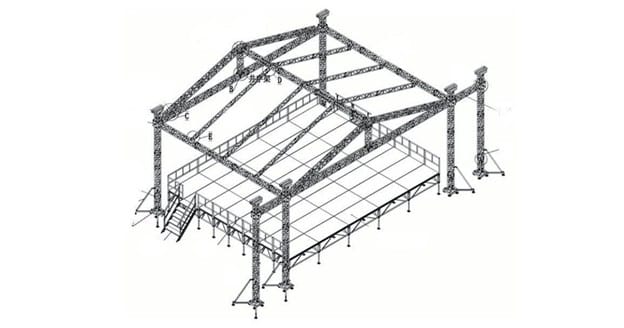
Structural diagram of a ground-supported stage roof system showing towers, roof trusses, bracing, and stage deck — every element is part of an engineered load path.
The 2011 Indiana State Fair investigation by Thornton Tomasetti found that the structure’s ballast system had “grossly inadequate capacity” to resist even the minimum code-specified wind speed of 68 mph — and it collapsed at an estimated 59 mph. No formal weather action protocol was in place, and no single authority was designated to make the evacuation call.
The 15 Red Flags: Detailed Reference Guide
Red Flag #1: Towers or Roof Masts Are Not Plumb
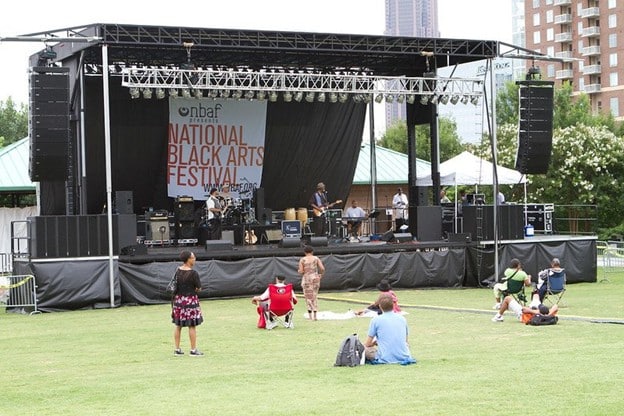
One of the most dangerous early warning signs is lean or drift in stage towers. A tower that is not plumb has already begun to experience uneven load distribution. Wind amplifies this imbalance exponentially.
Common Causes:
- Improper ballast placement or insufficient ballast weight
- Uneven, soft, or saturated ground beneath the base plate
- Wind pressure deforming the structure over time
- Incorrect or missing bracing connections
- Loose or missing pins and bolts at truss connections
- Overloaded rigging shifting the center of gravity
Visual Cues:
- Top of tower visibly leans inward or outward
- Towers appear to “rack” diagonally when viewed from front or side
- Roof corners fail to align at equal heights
- Plumb bob or digital level shows deviation of more than 1° from vertical
⚠ REQUIRED ACTION: Stop work immediately. Notify the Competent Person and AHJ. Do not resume until plumb is verified and cause identified. |
Red Flag #2: Missing, Wrong, or Improperly Installed Pins, Bolts, or Bracing
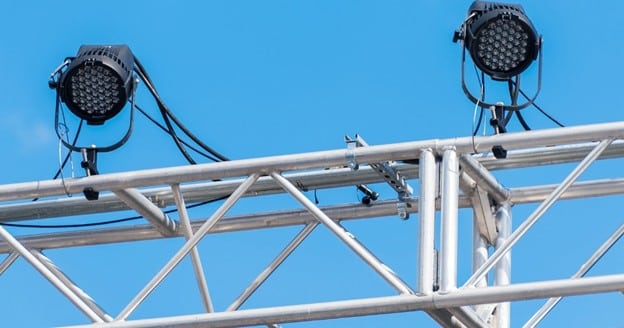
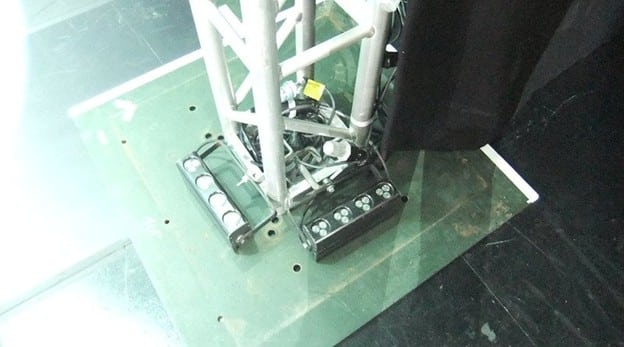
Truss and tower systems are engineered as complete systems. Every pin, bolt, and brace is load bearing. Missing or incorrect hardware is not a minor oversight, it is a structural failure waiting to occur.
- Bolts not fully threaded or seated
- Locking pins not clipped or cotter pins absent
- Wrong pin type, diameter, or grade substituted
- Braces missing entirely from engineered locations
- Cross-braces loose, slack, or visibly bowed
- Bent pins or hardware indicating previous overload
⚠ REQUIRED ACTION: Any missing or substituted hardware requires immediate documentation, reporting to the Competent Person, and written re-approval before the structure is loaded or raised. |
Red Flag #3: Ballast Has Shifted, Sunk, or Is Not Attached Correctly
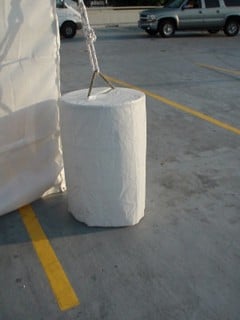
Ballast is the primary resistance to overturning forces in ground-supported stage systems. Any deviation from the engineered ballast plan is a structural safety failure.
| Water ballast
|
Key Failure Indicators:
• Ballast visibly leaning or tilting • Visible gap between ballast and ground • Water tanks not filled to specified capacity • Strap or chain attachment loose or missing • Ballast placed at incorrect distances from tower • Vehicle impacts causing misalignment • Water ballast evaporation on multi-day events • Active leaks reducing total weight |
|
|
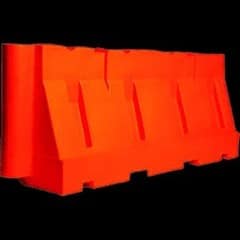
Historical Context: The 2011 Indiana State Fair investigation found that Jersey barrier ballast resisted overturning only through friction with the ground. When wind loads exceeded friction capacity, they slid below the 68-mph code minimum. |
⚠ REQUIRED ACTION: Ballast must be verified daily, after any rain event, and whenever ground conditions change. Deficiencies require immediate correction before operations resume. |
Red Flag #4: Ground Saturation or Soft Soil Under Towers or Ballast
Wet or unstable soil is one of the most underestimated collapse triggers in outdoor event production. Saturated soil can lose 50-80% of its bearing capacity compared to its dry state.
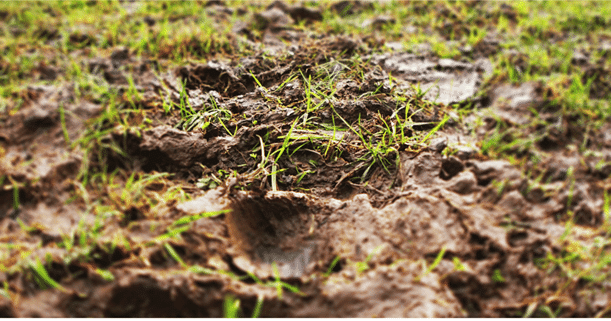
- Ballast slowly sinking into the ground surface
- Mud accumulating around tower base plates
- Spongy or compressible soil underfoot near tower footings
- Tower feet no longer fully level or in solid contact with ground
- Water pooling within 5 feet of tower bases
- Prior heavy rain event without post-rain soil inspection
⚠ REQUIRED ACTION: Conduct immediate post-rain inspections. If soil conditions are questionable, contact the structural engineer of record before resuming operations. |
Red Flag #5: Unusual Sounds: Creaking, Popping, or Grinding
Structures under stress often make noise before visual deformation appears. These sounds are the structure communicating that load paths are changing, connections are slipping, or members are being stressed beyond their normal working range.
- Metallic popping at truss joints indicates pin or bolt slippage
- Creaking at connection points under load cycling from wind
- Grinding between aluminum sections indicates relative movement
- Wire rope “pinging” as tension changes suddenly
- Guy wires snapping to new tension states or vibrating at high frequency
⚠ REQUIRED ACTION: Clear the structure and surrounding area immediately. Investigate the source before allowing any personnel to return to or beneath the structure. |
Red Flag #6: Excessive Sway, Oscillation, or Movement in Wind
All stage structures have some engineered flexibility but movement beyond design limits is a critical red flag. Resonance between wind gusts and the structure’s natural frequency can build catastrophically.
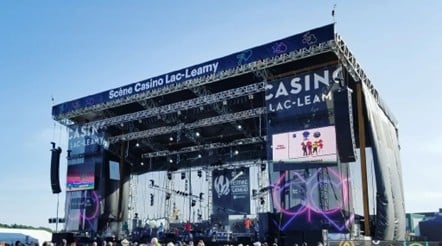
- Towers rocking noticeably from side to side in gusts
- Roof grid oscillating in a rhythmic side-to-side pattern (resonance)
- Unusual “bounce” when walking on the stage deck
- Guy wires alternately going slack then snapping taut
- Video walls swinging beyond minor oscillation
⚠ REQUIRED ACTION: Initiate weather response procedures. If sway cannot be attributed to a specific, correctable cause, clear the area and consult the structural engineer of record. |
Red Flag #7: Soft Goods Acting Like Sails (Wind Drag Pressure)
Banners, scrims, sound walls, curtains, and roof skins create wind drag that dramatically multiplies lateral and uplift forces on the structure. A full-coverage scrim wall of 40′ x 30′ has 1,200 square feet of sail area.
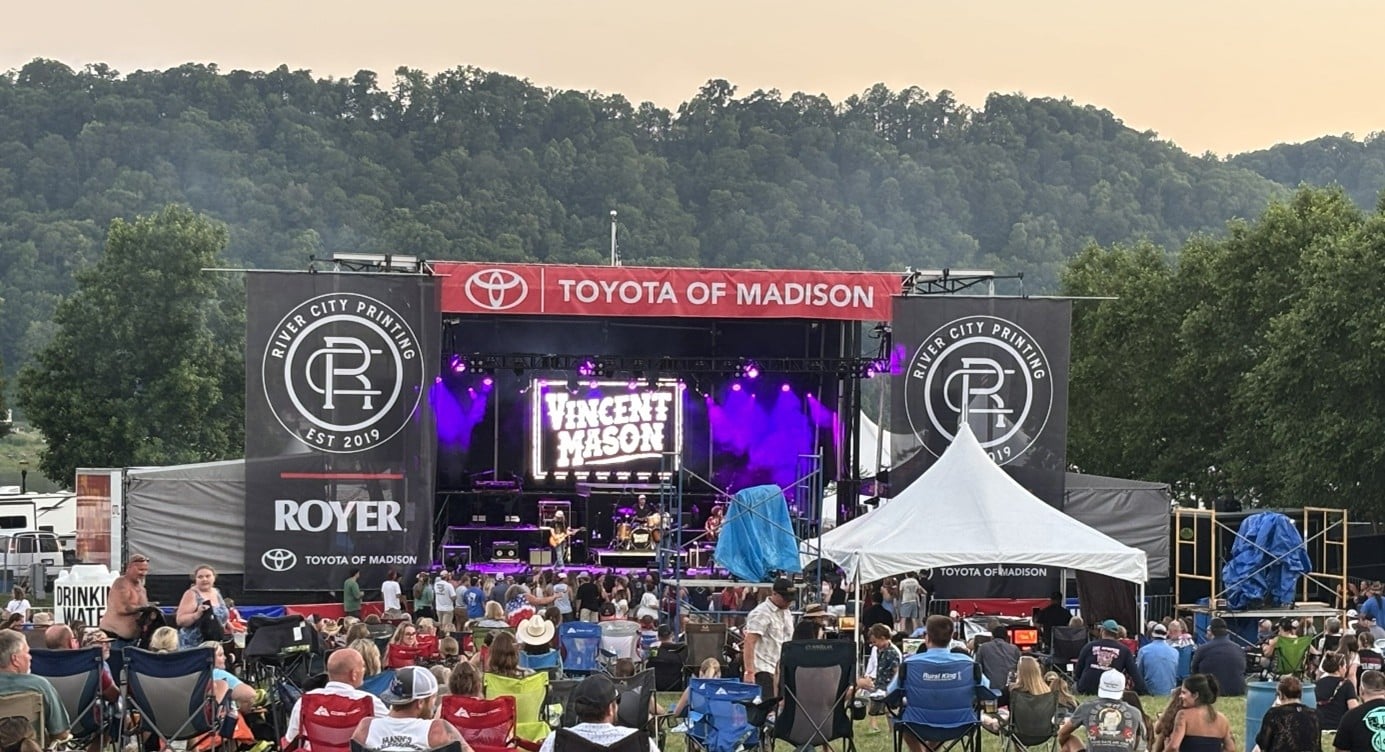
- Soft goods billowing or bowing heavily in wind
- Sound scrims pulling away from attachment points
- Roof skins tightening unnaturally or deforming under pressure
- Banners flapping aggressively or snapping at attachment hardware
- Wind “catching” under the roof skin creating upward pressure
⚠ REQUIRED ACTION: Remove or louver all soft goods when wind approaches the first action threshold. Do not wait for the second threshold. |
Red Flag #8: Rigging Loads Have Been Added, Moved, or Changed
Unauthorized rigging changes are one of the leading causes of structural overload at live events. Every element hanging from the structure is part of an engineered load plan.
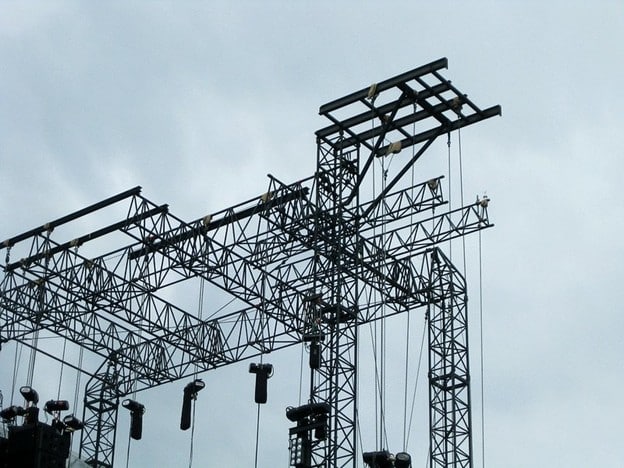
- Extra lighting fixtures added to truss without load review
- Video wall size increased from original specification
- Speaker arrays changed in configuration, size, or position
- New rigging points added on-site without stamped engineering
- Load spreader bars removed, changing point load distribution
⚠ REQUIRED ACTION: Any proposed change to rigging loads must be submitted to the structural engineer of record for written approval before implementation. No exceptions. |
Red Flag #9: Guy Wires Loose, Slack, or Changing Tension
Guy wires are primary lateral stabilization elements for many outdoor stage tower systems. A compromise in any part of the guy wire system reduces the structure’s lateral stability.
|
|
Red Flags:
• Visible slack or catenary sag in lines that should be taut • Guy wire angles inconsistent with engineered specifications • Uneven tension among wires in a matched set • Anchors visibly shifting, tilting, or beginning to pull free • Guy wires vibrating at high frequency (Aeolian vibration) • Attachment hardware showing deformation or wear
Guy wire re-tensioning is required after any significant weather event and at the beginning of each event day. |
⚠ REQUIRED ACTION: Immediately notify the Competent Person of any guy wire anomaly. Do not continue operations with slack, improperly tensioned, or damaged guy systems. |
Red Flag #10: Roof System Not Raising or Lowering Evenly
During the roof raise — one of the most critical operations in outdoor stage assembly — any uneven lifting is a serious structural red flag. Uneven lift creates torsional stress in the roof grid and unequal loads on towers.
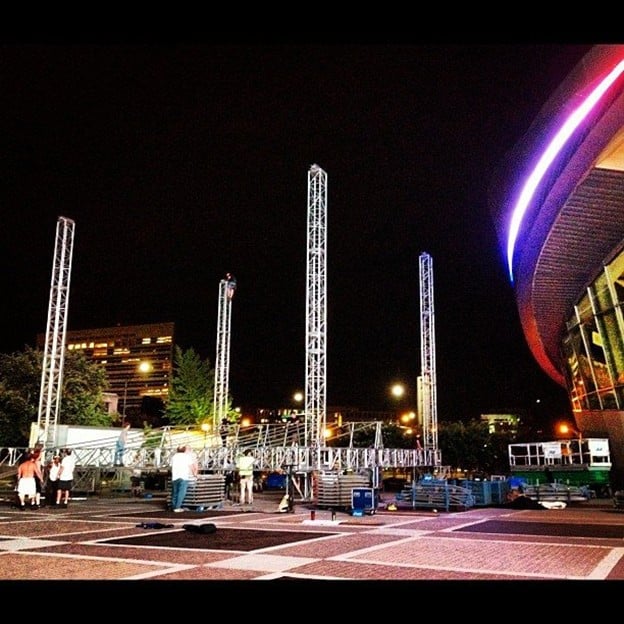
- One corner rises noticeably slower than others
- Motors straining audibly or thermally cutting out
- Roof grid visibly twisting during lift
- One tower visibly pulling or leaning during lift progression
- Hydraulic or motor control system showing errors or anomalies
⚠ REQUIRED ACTION: Stop the lift immediately. Lower the roof grid safely. Inspect all motors, rigging points, ballast, pins, and structural connections before any further lift attempt. |
Red Flag #11: Video Walls Swinging, Shifting, or Straining Motors
Video walls have become one of the dominant elements of modern live production — and one of the most wind-sensitive. A large LED video wall is effectively a solid wall with high sail area and significant weight.
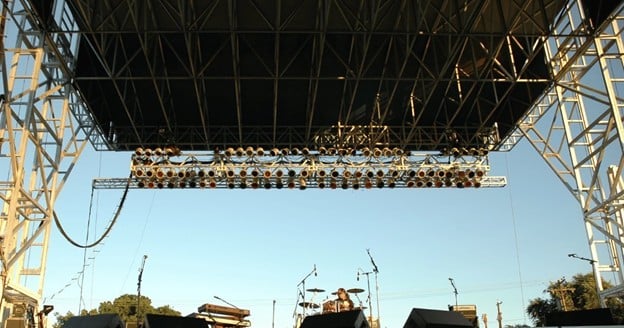
- Panels moving excessively in wind beyond minor oscillation
- Motors struggling to hold position or showing position errors
- Load spreading into unintended truss members due to panel movement
- Bottom of wall lifting from wind gusts creating uplift load
- Wall deforming, bowing, or showing panel separation
⚠ REQUIRED ACTION: Any video wall movement beyond minor oscillation requires evaluation by the Competent Person. Lower the video wall before reaching the first action threshold. |
Red Flag #12: Electrical Hazards Near the Stage Structure
Electrical hazards at outdoor events often appear in conjunction with other safety compromises such as weather deterioration, ground saturation, rushed setup, and load shifts. An electrical red flag should always trigger a broader safety review.
- Exposed cables lying in standing water
- Open or unsealed electrical distribution boxes in rain
- Damaged, abraded, or cut feeder cables
- GFCI devices tripping during weather events
- Generator grounding issues or ground fault alarms
A GFCI trip during a weather event signals ground saturation, water infiltration, or loose connections that may extend to structural systems. Electrical red flags are never isolated issues.
⚠ REQUIRED ACTION: Electrical red flags require immediate investigation and should trigger a comprehensive site safety review, not just electrical remediation. |
Red Flag #13: Weather Thresholds Have Been Reached or Are Nearing
Weather-related failures are the single most common cause of outdoor stage collapses. This is not because weather is unpredictable — it is because weather information is available but not acted upon.
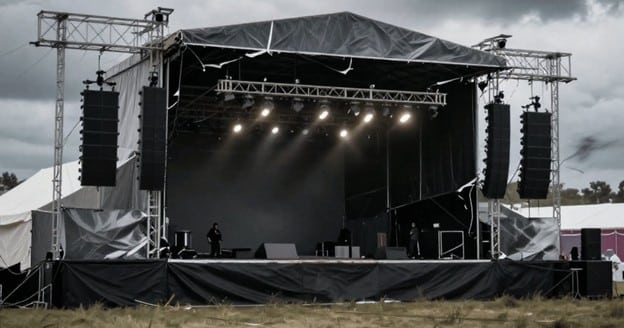
- Wind gusts approaching or at first action threshold (typically 25-30 mph for most systems)
- Radar showing rapidly developing storm cells within 10-20 miles
- Downdraft or outflow winds from convective storms can be notoriously sudden and severe
- Darkening, shelf cloud, or roll cloud formations on the horizon
- Sudden temperature drops of 5°F+ indicating cold outflow
- Lightning within an 8 to10-mile radius triggering weather action alert
WEATHER ACTION PLANS MUST BE ENFORCEABLE. DELAYS IN WEATHER DECISIONS KILL PEOPLE. |
At the 2011 Indiana State Fair, there was no designated authority to make the evacuation call. The decision was delayed. Seven people died. Weather decisions must be made by a designated, empowered individual using pre-defined criteria.
⚠ REQUIRED ACTION: When thresholds are reached: Begin the shutdown sequence, lower the roof, remove soft goods, or initiate evacuation. Do not delay for commercial reasons. |
Red Flag #14: Stage Hands or Crew Express Concern
One of the most consistently overlooked red flags is direct human observation. Experienced stagehands spend more time in physical contact with staging structures than any inspector.
- “This doesn’t look right.”
- “The tower seems off — it wasn’t like this yesterday.”
- “The ballast moved last night.”
- “The roof is fighting the motors.”
- “That pin doesn’t look right to me.”
Creating a culture where crew members feel safe raising concerns without fear of being dismissed or blamed for delays is one of the most powerful safety investments an event organization can make.
⚠ REQUIRED ACTION: Any crew concern about structural safety must be treated as a formal red flag and investigated by the Competent Person before operations resume. |
Red Flag #15: Past-Due Inspections or Missing Documentation
Documentation is not administrative overhead. It is the paper trail that proves the structure was engineered, inspected, loaded within capacity, and operated according to its approved design.
- Stamped engineering drawings from a licensed Professional Engineer
- Load charts for all rigging points
- Ballast plan verified against engineer of record specification
- Weather Action Plan with defined thresholds and decision authorities
- Inspection logs from assembly through event operations
- Electrical permits and grounding verification documentation
- AHJ approval signature or acceptance documentation
⚠ REQUIRED ACTION: If documentation is incomplete or absent, the structure cannot be considered safe for public occupancy. Operations must not commence until all required documentation is obtained and verified. |
Quick Reference: Red Flag Summary
| # | Red Flag | Primary Cause | Required Action |
| 1 | Towers not plumb | Ballast / soil / wind | Stop work immediately |
| 2 | Missing/wrong hardware | Rushed assembly | Document & report to CP |
| 3 | Ballast shifted/incorrect | Ground movement / improper setup | Re-verify & correct immediately |
| 4 | Soft/saturated ground | Rain / poor site | Post-rain inspection required |
| 5 | Unusual sounds | Overstress / loose connections | Clear structure & investigate |
| 6 | Excessive sway | Insufficient ballast / wind | Initiate weather response |
| 7 | Soft goods as sails | Wind + uncovered fabric | Remove at first threshold |
| 8 | Unauthorized rigging changes | Last-minute production changes | Re-engineering required |
| 9 | Guy wire issues | Soil failure / installation error | Notify CP immediately |
| 10 | Uneven roof raise | Misalignment / motor failure | Stop lift & inspect all |
| 11 | Video wall movement | Wind + high sail area | Lower before threshold |
| 12 | Electrical hazards | Water infiltration / damage | Broad site safety review |
| 13 | Weather thresholds reached | Storm approach | Execute Weather Action Plan |
| 14 | Crew concerns raised | Observed anomaly | Trigger formal inspection |
| 15 | Missing documentation | Vendor non-compliance | Do not occupy structure |
Frequently Asked Questions (FAQ)
The following questions reflect what event organizers, venue managers, AHJs, and production crews most commonly ask about stage structural safety. Answers are based on engineering investigation findings, ANSI E1.21 standards, and real-world incident data.
| Q: Who is legally responsible if a stage collapses at my event? |
| A: Liability typically extends to multiple parties: the event organizer, the staging vendor, the structural engineer of record (if one was engaged), and in some cases the venue and AHJ. The 2011 Indiana State Fair litigation resulted in settlements involving the staging contractor, concert promoter, and state fair commission. The key determining factors are who had control over the structure, whether engineering drawings were stamped and followed, whether a Weather Action Plan existed and was enforced, and whether inspection records were maintained. Consulting legal counsel and carrying appropriate event liability insurance are essential. |
| Q: Is a stamped engineering drawing legally required for outdoor stages? |
| A: Requirements vary by jurisdiction, but the 2024 International Building Code (IBC) Chapter 31 now explicitly addresses temporary entertainment structures and references ANSI E1.21 standards. Many states and counties require a PE-stamped engineering drawing and AHJ permit for stages above a certain height or occupancy threshold. Major mobile stage manufacturers furnish such engineering documentation for their stages. The Indiana State Fair investigation noted that no inspection was required because the structure was temporary, a gap in requirements that has since driven many jurisdictions to update their codes. Always verify local AHJ requirements well in advance of your event date. |
| Q: What wind speed should trigger a stage shutdown? |
| A: ANSI E1.21 requires that every structure have a site-specific Operations and Maintenance Plan (OMP) that includes weather threshold triggers. These thresholds must be determined by the structural engineer of record based on actual design calculations for that specific structure, not industry rules of thumb. As a general reference, many systems specify a first action threshold around 25–30 mph sustained wind and a mandatory shutdown around 40 mph, but your structure’s engineered limits may be lower or higher. Never use generic industry averages as your actual threshold. The OMP must be in writing and the authority to act on it clearly designated. |
| Q: Who is the ‘Competent Person’ and do I need one at every event? |
| A: The Competent Person (CP) is defined in ANSI E1.21 as someone capable of identifying existing and predictable hazards related to the temporary structure and who has authority to take prompt corrective measures to eliminate those hazards. This is not an optional role. ANSI E1.21 requires a designated CP for structures within its scope. The CP should be on-site during assembly, operation, and disassembly. They are typically the head rigger or staging supervisor from the structural vendor, but the designation must be explicit and documented. |
| Q: My event is small — do these rules apply to me? |
| A: Size does not determine structural risk. Stage collapses have occurred at small county fairs, local festivals, and private events just as readily as at large productions. ANSI E1.21 and IBC requirements apply based on the type and height of structure. IBC requirements apply to any stage greater than 120 sq. ft, not the size of the crowd. Many of the most preventable collapses have occurred at smaller events precisely because there was less safety infrastructure in place. The size of the crowd determines the consequence of failure, not the probability of it. |
| Q: What should a Weather Action Plan include? |
| A: A compliant Weather Action Plan should include: (1) the source of weather monitoring (a professional meteorological service is strongly preferred over free apps or NWS alone), (2) the specific wind speed thresholds at which actions are triggered, (3) the step-by-step actions to be taken at each threshold (e.g., remove soft goods at 25-30 mph, lower roof at 40 mph and initiate evacuation), (4) the identity and authority of the single designated decision-maker empowered to call each action without requiring consensus, and (5) the communication chain to notify crew, security, venue, and emergency services. The plan must be distributed in writing to all relevant parties before the event begins. |
| Q: How do I know if my staging vendor is qualified? |
| A: Ask for proof of the following: a portfolio of similar-scale events, references from comparable productions, current general liability and workers’ compensation insurance certificates, the name of the licensed Professional Engineer who will stamp the engineering drawings, a sample OMP from a prior event, and copies of ANSI E1.21 compliance documentation. A qualified vendor will answer all these questions immediately and in writing. Hesitation or evasiveness on any of these points is itself a red flag. |
| Q: Can I re-use a stage structure from a previous event without new engineering? |
| A: In most cases, no. ANSI E1.21 requires that load calculations account for site-specific conditions: soil type and bearing capacity, local wind speed design values, elevation, terrain, and the specific equipment to be hung. A structure that was properly engineered for one site and load configuration may not be safe at a different site or with different rigging. Components that have been transported and reassembled also require inspection for damage before reuse. Aluminum trusses degrade under repeated loading — ANSI E1.21 requires a load reduction factor of 0.85 for components used at multiple events. |
| Q: What happens after a red flag is identified? Who makes the call? |
| A: When any of the 15 red flags in this document is identified, the observer must immediately report it to the designated Competent Person. The CP is empowered and required to make the safety call, including stopping work, clearing the area, or initiating shutdown without waiting for approval from event organizers, venue management, or performers. If the CP is unavailable or fails to act, the observer should escalate directly to the AHJ or call emergency services. No commercial interest, schedule pressure, or hierarchy overrides the obligation to address a structural safety threat. This is the lesson of Indiana, Ottawa, Toronto, and every other documented collapse. |
| Q: Where can I get training in stage structural safety? |
| A: The Event Safety Alliance (eventsafetyalliance.org) offers online courses, in-person workshops, and an annual conference covering structural safety, weather response, and crowd management. IATSE locals offer rigging and safety certifications. ESTA’s Technical Standards Program (esta.org) publishes ANSI standards including E1.21 and related documents. The Entertainment Technician Certification Program (ETCP) offers certifications for riggers and entertainment electricians. For AHJs and building officials, the ICC (iccsafe.org) provides code training specific to temporary structures. |
Conclusion: Red Flags Save Lives — If Acted Upon
Outdoor stage structures rarely fail without warning. Collapses occur when red flags were ignored, weather thresholds were bypassed for commercial reasons, unauthorized changes were made, or documentation was absent.
Every person on site, from the stagehand setting base plates to the AHJ reviewing permits to the production manager approving last-minute additions — is part of the safety system. Red flag recognition is not a specialty skill reserved for engineers. It is a shared professional responsibility.
Outdoor stages don’t fail silently.They always speak first.We simply must listen. |
References & Further Reading
All references below include direct links to source materials. Links to official standards stores (ANSI, NFPA, ICC) may require purchase for full-document access.
| 1 | Thornton Tomasetti — Indiana State Fair Commission Collapse Investigation Report (April 2012)
https://www.thorntontomasetti.com/resource/indiana-state-fair-collapse-incident-anatomy-failure The engineering firm’s official resource page for the Indiana State Fair collapse investigation, including the cause-and-origin analysis, ballast system failure findings, and structural recommendations. |
| 2 | Thornton Tomasetti — Full Investigation Report PDF (via AWS/S3 archive)
http://s3.amazonaws.com/tt_assets/pdf/TT_Indiana_State_Fair_Commission_Investigation_Report.pdf Direct PDF link to the complete Thornton Tomasetti technical investigation report. Contains laser scanning data, wind tunnel analysis, ballast failure analysis, and engineering recommendations. |
| 3 | Witt Associates — Independent Assessment of the Indiana State Fair Collapse Incident (2012)
https://en.wikipedia.org/wiki/Indiana_State_Fair_stage_collapse Wikipedia’s comprehensive summary of the collapse with citations to both the Thornton Tomasetti and Witt Associates reports. Witt focused on emergency preparedness, decision-making authority, and weather response failures. |
| 4 | Event Safety Alliance — Standards & Guidance (including The Event Safety Guide)
https://eventsafetyalliance.org/standards-guidance The ESA’s standards and guidance library, including The Event Safety Guide — the U.S. industry’s primary operational safety reference. The Guide is now available as a free PDF download from this page. |
| 5 | ANSI E1.21-2023 — Temporary Structures Used for Technical Production of Outdoor Entertainment Events (ANSI Webstore)
https://webstore.ansi.org/standards/ESTA/ansie1212023 The current edition of ANSI E1.21, now harmonized with the 2024 International Building Code. Establishes minimum design and performance parameters for temporary outdoor entertainment structures. Purchase required. |
| 6 | ANSI E1.21-2020 — Free PDF (via NUTheatreStock educational resource)
The 2020 edition of ANSI E1.21 available as a free PDF through an educational resource site. Contains the full standard text including OMP requirements, weather threshold provisions, and competent person definitions. |
| 7 | International Building Code (IBC) 2024 — Chapter 31: Special Construction / Temporary Structures (ICC Webstore)
https://codes.iccsafe.org/content/IBC2024P1 The 2024 IBC now includes updated provisions for temporary entertainment structures referencing ANSI E1.21. Available through the ICC’s online code library. Chapter 31 covers temporary structures, occupancy requirements, and structural inspection. |
| 8 | OSHA 29 CFR 1926 — Construction Safety Standards (relevant to temporary entertainment structures)
https://www.osha.gov/laws-regs/regulations/standardnumber/1926 OSHA’s construction safety standards applicable to temporary structure assembly workers. Covers fall protection, rigging, electrical safety, and personal protective equipment requirements. |
| 9 | Rapp, Randy R. — ‘Song, Wind, and Mayhem: The Indiana State Fair Stage Collapse’ (Journal of Emergency Management, Feb. 2024)
https://wmpllc.org/ojs/index.php/jem/article/view/3582 Peer-reviewed academic analysis of both the technical and managerial failures of the Indiana State Fair collapse. Examines IBC 2024 code changes driven by the incident and continuing lessons for event planners and AHJs. |
| 10 | ESTA Technical Standards Program — Full list of ANSI entertainment technology standards
https://entertainingsafety.com/knowledge-base/esta-technical-standards-program/ Comprehensive listing of all ANSI standards developed under ESTA’s Technical Standards Program, including E1.21, E1.47 (Rigging System Inspections), E1.39 (Fall Arrest Systems), and related documents. |
| 11 | TSE Entertainment — Outdoor Stage Safety Compliance Handbook
https://tseentertainment.com/outdoor-stage-safety-compliance-handbook/ Comprehensive handbook dealing with the safety issues, standards, and permitting of outdoor stages. |
TSE Entertainment, LLC — Event Safety Resources
This document is provided for educational and informational purposes. Always consult a licensed structural engineer and qualified Competent Person for site-specific safety determinations.